What Is a Test Oracle in an Autonomous Software Factory?
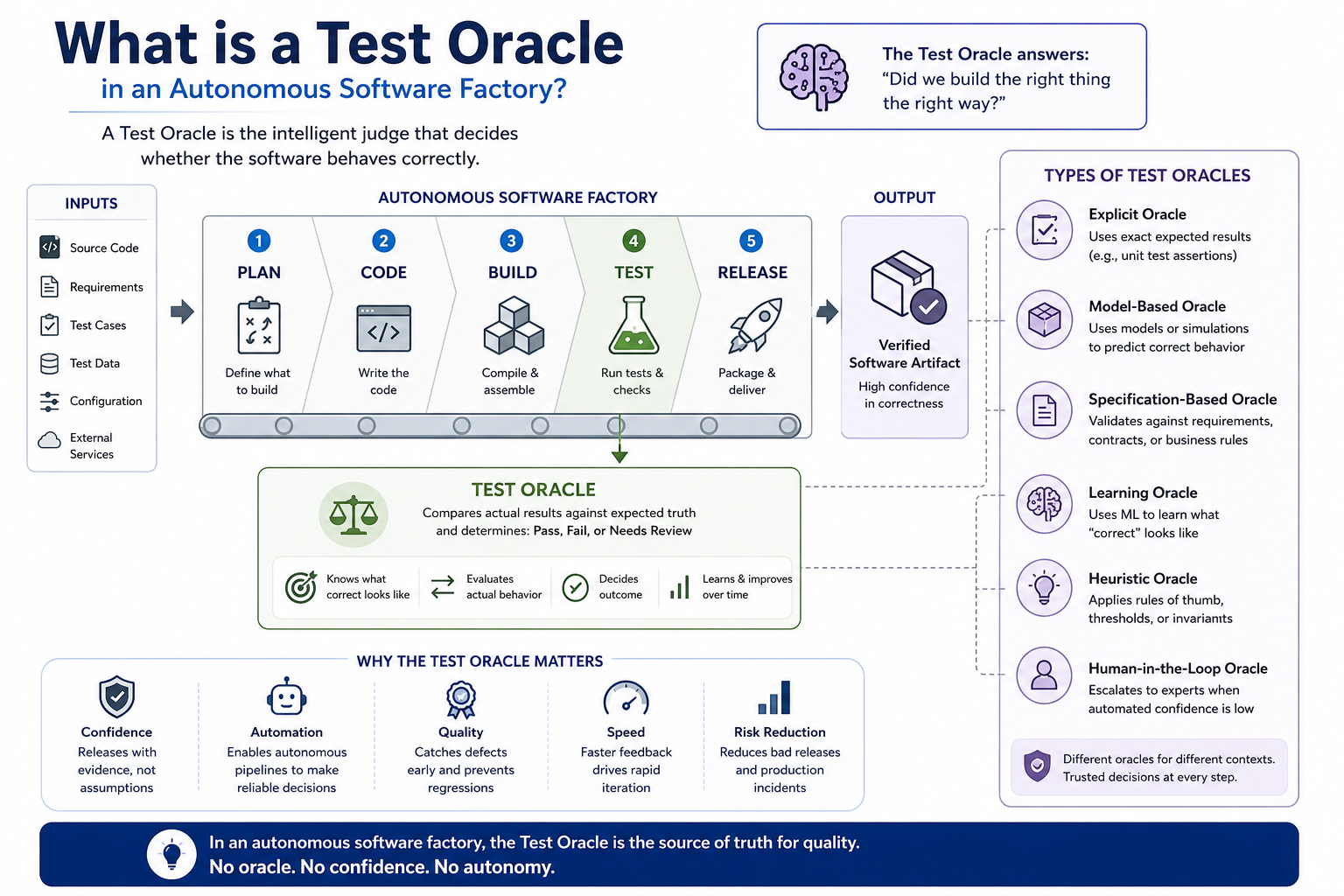
The concept of a test oracle is simple: it's the mechanism that tells you whether your code passed or failed. But in the context of an autonomous software factory, where code is generated, tested, and deployed with minimal human intervention, the quality of that oracle determines whether the entire system can be trusted. Weak oracles are the single biggest blocker to lights-out deployment, and measuring oracle strength is the factory's most important governance function.
The Classical Definition
A test oracle is any mechanism that determines whether a program's behaviour matches the expected result. In traditional software engineering, that oracle is usually a human reading a test report, or a test suite with assertions written by a developer. The word comes from the Oracle of Delphi, a source of truth you consult when you need a verdict.
The problem is that most test suites in practice are weak oracles: they execute a lot of code but assert very little. High code coverage with low assertion density gives you a false sense of security. Your tests pass, so you think the code is correct. But they pass because they barely check anything.
Why Weak Oracles Fail Autonomous Factories
The Fable Software Factory overview identifies seven failure fronts for autonomous factories. The first one is weak test oracles. That's telling.
An autonomous factory makes decisions without a human in the loop. It generates code, runs tests, and if the tests pass, it deploys. If the test oracle is weak, passing when it should fail, the factory will ship defects confidently and at speed. That's worse than a human shipping a defect, because there's no pause, no hesitation, no second-guessing. The factory just keeps going, compounding the damage across every change.
Measuring Oracle Strength Through Mutation Testing
The factory doesn't rely on coverage percentages or hand-waving about test quality. It measures oracle strength directly via mutation testing: introducing small, deliberate faults (mutants) into the code and checking whether the test suite catches them.
The mutation-kill-rate, the percentage of mutants the oracle kills, becomes a direct, empirical measure of oracle strength. This turns a fuzzy quality concern into a numeric input for governance. You can't argue with a number. You can't hand-wave past a measured kill-rate.
The Oracle-Strength Floor as a Policy Gate
Every change moving through the factory hits a risk tier gate. That gate carries an oracle-strength floor, the minimum mutation-kill-rate a change's test oracle must achieve before the gate will pass it.
If the measured strength is below the floor, the change gets routed to a human reviewer. This is encoded in policy (OPA/Cedar Rego), not in prose, and enforced at the gate. The factory glossary describes it as "autonomy capped at measured oracle strength", expressed as code rather than policy prose. It's a direct, verifiable fix for the weak oracle problem.
The gate also carries a risk-band that determines how sensitive it is: a high-risk change gets flagged to a human regardless of tier or oracle strength. The combination of oracle-strength floor and risk-band routing means the factory can scale autonomy precisely: more autonomy where the oracle is proven strong, less where it isn't.
What This Means for AI Code Generation
AI code generation makes this problem acute. An LLM can produce thousands of lines of code per day, far more than a human team can manually review. If the test oracle is weak, the factory will deploy AI-generated defects faster than any human team could produce them.
The only scalable defence is an oracle-strength floor that grows as autonomy increases. Low-autonomy work (always human-reviewed) can survive a weak oracle. High-autonomy work (lights-out deployment) requires a certified oracle-strength floor proven by mutation testing. The two must scale together.
This is the direct fix for the test oracle problem: not more tests, but a measured, enforced standard for test quality. Without it, AI code generation is just accelerating the production of undetected defects. With it, you have a factory that knows what it doesn't know and routes accordingly.
Ready to put these ideas into practice?
Book a free 30-minute consultation to discuss how AI-driven delivery engineering can transform your organisation.
Book a Strategy Call